

The reward for memorizing the Quran in Islam is among the highest promised to any believer. The Prophet Muhammad ﷺ described it across multiple authentic Hadiths, a crown of light for parents, intercession for family members, and a rank in Jannah elevated with every verse recited.
This guide covers every major reward, the scholarly conditions attached to them, and the misconceptions most people carry about who actually qualifies.
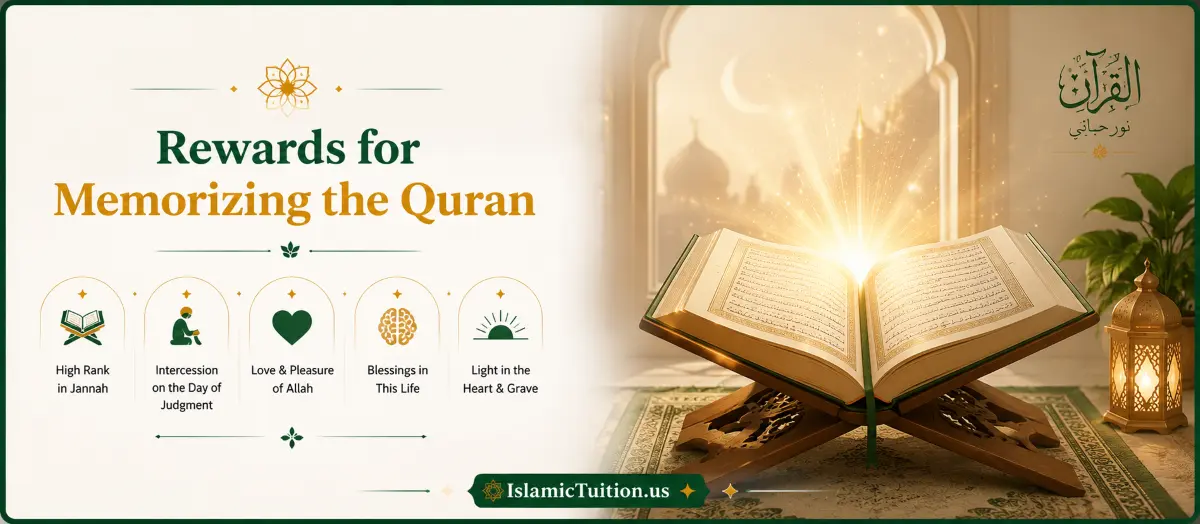
The Core Rewards – Authentic Hadith Evidence
Some of the blessings and rewards for a Hafiz of the Qur’an
A Crown of Light for the Parents
The Prophet ﷺ said: “Whoever memorizes the Quran and acts upon it, Allah will crown his parents with a crown of light on the Day of Judgment, whose brightness will be like that of the sun. And his parents will be clothed with garments which are far better than this world and what it contains.” (Abu Dawud – graded Hasan)
This single Hadith is the reason many Muslim parents in the USA enroll their children in Hifz. The reward is not only for the memorizer, but it also extends directly to the parents who raised and supported them.
Intercession for Ten Family Members
“The Hafiz of the Quran will intercede for ten of his family members, all of whom had been destined for Hellfire.” (Abu Dawud, Ibn Majah)
Scholars note this intercession is specifically for family, a direct connection between one person’s Hifz and the akhirah outcome of those closest to them.
Rank Elevated in Jannah With Every Verse
“It will be said to the companion of the Quran: Recite and ascend. Recite as you used to recite in the world, for your rank will be at the last verse you recite.” (Tirmidhi – graded Sahih)
The higher a person’s memorization, the higher their station in Jannah. Every additional Surah, every additional Juzz memorized corresponds directly to a higher level.
Does Partial Memorization Count?
The rewards above apply to the Hafiz who memorizes the complete Quran. But partial memorization carries its own significant reward. The Prophet ﷺ said:
“The one who recites the Quran and struggles with it will have a double reward.” (Bukhari and Muslim)
This Hadith applies to anyone who engages sincerely with Quran memorization, even if they never complete it. A student who memorizes Juzz Amma and uses those Surahs in daily Salah is accumulating reward with every recitation throughout their life. As we covered in our post on can adults memorize the Quran, even beginning with a few Surahs is a meaningful and rewarded act.
The Reward for the Teacher of a Hafiz
The Prophet ﷺ said: “Whoever guides someone to goodness will have a reward like the one who did it.” (Muslim)
A qualified Quran teacher who guides a student to Hifz shares in the ongoing reward of that student’s memorization. This is one reason why teaching the Quran and learning from a properly certified tutor carries weight beyond the classroom. Our Quran memorization course is taught exclusively by Ijazah-certified tutors whose chain of transmission connects back to the Prophet ﷺ himself.
Myth vs Reality – Common Misconceptions
| Myth | Reality |
|---|---|
| Only full Quran memorization earns reward | Every Surah memorized carries reward. Partial Hifz is not unrewarded. |
| If you forget, you lose your reward | Forgetting due to genuine difficulty differs from neglect. Scholars distinguish between the two. |
| Adults receive less reward than children | Reward is based on sincerity and effort, not age. The struggling adult reciter earns double reward per the Hadith. |
| The reward is automatic regardless of how you live | Scholars attach conditions, act upon what is memorized, and maintain it with sincerity (Ikhlas). |
Does Forgetting Quran After Memorizing Remove the Reward?
The Prophet ﷺ warned strongly against neglecting memorization: “Whoever memorizes the Quran and then forgets it out of negligence will meet Allah on the Day of Judgment as one who is afflicted.” (Abu Dawud)
However, scholars, including Ibn Hajar Al-Asqalani, distinguish clearly between the two situations. Forgetting due to deliberate neglect, abandoning revision without reason, carries the warning above. Forgetting despite genuine effort to maintain memorization, due to illness, age, or life circumstances, is a different matter entirely and does not carry the same ruling.
The practical implication: consistent daily revision is not just about retention. It is an act of worship in itself. For a structured approach to maintaining memorization, our post on how to maintain Quran memorization covers the Sabaq, Sabqi, and Manzil revision system in detail.
The Scholarly Conditions Attached to These Rewards
Scholars of Hadith and Fiqh consistently note that the rewards described above are connected to specific conditions. Listing Hadiths without these conditions gives an incomplete picture.
- Acting upon the memorization – reciting in Salah, living by what is memorized
- Maintaining the memorization – regular daily revision, not abandoning it after completion
- Sincerity of intention (Ikhlas) – memorizing for the sake of Allah SWT, not for status or praise
- Correct pronunciation – memorizing with proper Tajweed and Makhaarij as the Quran was revealed
These conditions do not diminish the reward. They define it. A Hafiz who memorizes with these qualities earns the full promise of the Hadiths above.
Frequently Asked Questions
A crown of light on the Day of Judgment, brighter than the sun, per an authentic Hadith in Abu Dawud.
Yes – the Prophet ﷺ confirmed the struggling reciter receives double reward (Bukhari and Muslim).
Forgetting through neglect is warned against. Forgetting despite genuine effort is treated differently by scholars.
Yes, the teacher shares in the ongoing reward of the student’s memorization per the Hadith on guiding others to goodness.